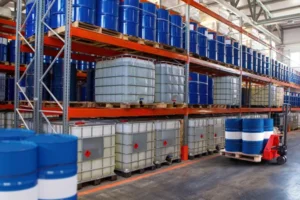
Professional sales packaging:
buckets, cans, drums, pouches and other packaging used to sell ingredients, raw materials or finished products to professionals.
EPR scheme for professional packaging
In the food industry, the EPR scheme for professional packaging (EPRO) comes on top of already stringent requirements for food safety, food contact and traceability. With flows that may fall under both household and professional packaging schemes, a wide variety of formats and preservation performance to maintain, every packaging choice must reconcile compliance, product protection and circularity.
EPRO applies from 1 January 2027. Twiice helps you classify your flows, prepare for compliance and identify levers for improvement suited to food industry constraints.
Food industry companies are subject to the scheme as soon as they place products on the French market in packaging covered by the EPR scheme for professional packaging (EPRO). For companies that sell to households, food service, wholesalers or other manufacturers, one of the first challenges is to distinguish precisely between household and professional packaging, so that each flow is allocated to the right EPR scheme.
The scheme covers in particular:
buckets, cans, drums, pouches and other packaging used to sell ingredients, raw materials or finished products to professionals.
crates, trays, boxes, displays and other formats used to group several units.
pallets, stretch film, covers, layer pads and other packaging used in logistics flows.
Our packaging flow analysis helps you identify precisely your status as a producer placing packaging on the market and the packaging flows covered by EPR.
Retail, food service, wholesale and industrial customers are often supplied from the same product catalogue. Mapping formats and sales channels is essential to allocate each flow to the right EPR scheme and avoid incorrect allocation or double declarations.
Moisture, oxygen or light barriers, sealing, preservation, resistance to industrial processes and food-contact requirements may call for complex materials or structures. Reduction, recyclability, recycled content and reuse must remain compatible with regulatory and health requirements.
Trays, crates, pallets, drums and some food containers already circulate in professional loops. Return, washing, cleaning and, where necessary, disinfection conditions must be controlled, together with contamination risks.
EPR adds data on packaging type, materials, weight, household or professional status, reusability and rotations. The challenge is to connect packaging data to existing systems and processes.
Any company that packs, has products packed or imports packaged products intended for professionals may be considered a producer placing packaging on the market. When the scheme comes into force, you will need to:
Food manufacturers, central kitchens, restaurants, wholesalers and other professionals that unpack or use raw materials, ingredients or finished products generate packaging waste and are considered waste holders. You will need to:
Waste holders are not required to join an EPR scheme for the packaging they receive, but they play an essential role in reuse, sorting and recovery.
Common situations requiring careful analysis include products sold through both household and professional channels, private-label packing, co-packing, imports of pre-packed food products, and grouped or transport packaging associated with products in household packaging.
Each situation must be assessed flow by flow to identify who is responsible for placing the packaging on the market and which EPR scheme applies.
Food industry packaging cannot be treated as a single category. Twiice starts from the reality of each flow (destination, function, materials and constraints of use) to turn EPR into an action plan tailored to your business.
Twiice helps you map formats, capacities, materials, logistics functions and destinations to determine your status, the packaging in scope and the data you need for compliance.
Twiice helps you structure the packaging data required for your declarations and connect it with your existing traceability systems.
Identify reusable formats and secure return, washing and traceability loops while protecting food safety.
Identify levers linked to reduction, reuse, recyclability and recycled plastic content.
Packaging waste assessment
A partner expert maps your packaging flows on site, analyses your practices and identifies priority levers for reduction, reuse and recycling. The outcome: an operational roadmap.
For producers placing packaging on the market and waste holders (funded by Twiice)
Sorting at source
Setting up separate sorting on your sites, with guidance adapted to technical packaging in the food industry, team support and consolidation of flows towards recycling channels.
For producers placing packaging on the market and waste holders (funded by Twiice)
Equipment purchases
Support for purchasing pre-collection equipment to improve the separation, storage and management of your packaging flows, including containers that require prior decontamination.
For producers placing packaging on the market and waste holders (funded by Twiice through calls for projects)
Awareness & Communication Kit
Educational tools and suitable signage to help your teams apply good practices for sorting and managing plastic packaging.
For producers placing packaging on the market and waste holders (produced by Twiice)
Industrial investment
Support for targeted investment to improve the collection, sorting and treatment of professional plastic packaging.
For producers placing packaging on the market and waste holders (funded by Twiice through calls for projects)
Recycled plastic incorporation / IMPR
Do you incorporate recycled plastic into your packaging? Twiice funds traceability audits to certify your recycled content rates and access the premium: up to €1,000 per tonne for resins that are difficult to recycle.
For producers placing packaging on the market and waste holders (funded by Twiice)
MyRecycledContent
Looking to secure your supply of recycled plastics? MyRecycledContent, our responsible purchasing platform, connects you with a network of qualified suppliers offering certified packaging that incorporates recycled materials.
Discover our services and all our financial support for producers placing packaging on the market and packaging waste holders.
Flow classification, compliance, reuse and recyclability: Twiice supports food industry companies in turning their EPR obligations into levers for performance and circularity.
The EPR scheme for professional packaging comes into effect on 1 January 2027. Companies concerned should therefore prepare in advance by identifying their professional packaging, collecting the necessary data and organising their declaration process.
Yes, as long as it places products on the French market in packaging that falls within the professional scope. However, a food industry business may also place on the market packaging that falls under household packaging EPR. It is therefore necessary to analyse its different formats and sales channels.
The distinction is not based solely on whether your customer is a professional. The regulations take into account, in particular, the nature and function of the packaging, its capacity and, in some cases, the intended destination of the packaged product.
Because companies are already subject to strict traceability requirements for products and food-contact materials.
EPR adds information on the type, weight, materials, status and end-of-life destination of packaging. The challenge is to connect this information to existing systems rather than build a separate, isolated data chain.
Yes. Grouped and transport packaging are included: cardboard boxes, pallets, crates, films, strapping, stillages, protective inserts, layer pads, etc.
It depends on the packaging and the material. For materials intended for food contact, the use of recycled material must remain compatible with the applicable food-contact regulations. Optimising the eco-contribution must therefore be considered alongside health, technical and product preservation requirements.
Yes, where the packaging and the reuse loop are suitable. Developing reuse must take account of return, cleaning and, where necessary, disinfection conditions, as well as container traceability. Whether a loop is suitable therefore depends as much on the packaging design as on the organisation that allows it to be put back into circulation under appropriate conditions.
Yes.
For example, you may be responsible for some packaging that you place on the market while also holding packaging received with raw materials or products used on your own sites.
These two responsibilities relate to different flows and can apply at the same time.
Check out our FAQs or start a conversation with Eliia, our AI agent.
At the heart of packaging flows, the sector plays a key role in traceability, reuse and putting packaging back into circulation.
Protective inserts, foams, pallet stretch film and site packaging: the construction sector generates large volumes of industrial packaging subject to EPR. Twiice works in this sector in partnership with Valobat.
Cans, drums, jerrycans, IBCs: chemical product packaging has its own rules.