
Questions about the rates or your situation ?
Our teams are here to support you every step of the way.
The new Twiice 2027 eco-contribution rates are now available. So, what has changed compared with 2026? Why have the rates changed? And what exactly does your eco-contribution fund?
You are subject to the Extended Producer Responsibility (EPR) scheme for Professional Packaging — or you are still wondering whether you are, in which case our free questionnaire can help you find out. You have identified the packaging flows you will need to declare (and our packaging flow analysis tool can help you with that too). Now, one key question remains: how much will you pay in eco-contributions in 2027 ?
The new Twiice 2027 eco-contribution rates are now available.
So, what’s changing compared with 2026? Why are rates changing? And what exactly does your eco-contribution fund ?
Here’s what you need to know.
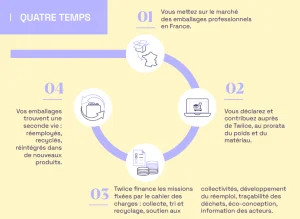
The eco-contribution is not a tax. It is used to fund the EPR scheme.
The amount of your eco-contribution depends in particular on the materials and quantities of packaging you place on the market, as well as the costs associated with managing that packaging at the end of its life and the targets set for the scheme.
As not-for-profit eco-organisation, Twiice uses the funds collected to support the sector and give professional packaging a second life. Your eco-contribution therefore helps fund end-of-life packaging management, as well as initiatives designed to improve the performance of the entire sector.
In 2027, new cost components required under the scheme’s approval specifications are included in the calculation. They explain much of the change in the rates, particularly for plastic.
The change in the plastic rate is mainly explained by two complementary mechanisms.
The recycled content bonus (IMPR), provided for under Article 2.1.1 of the scheme’s approved specifications, is paid to producers placing packaging on the market according to the quantity of recycled plastic incorporated into their packaging.
In other words, part of the funds collected directly supports companies that use recycled plastic in their packaging.
At the same time, the funding allocated to incentivising recycling enables Twiice to finance its “Boosters” programme, including investment support, funding for sorting-at-source costs and co-financing for action plans.
The two mechanisms work hand in hand: the IMPR bonus encourages the use of recycled materials, while recycling support helps develop the collection and sorting capacity needed to supply them.
These mechanisms are already operational at Twiice, with funded packaging waste audits funded up to €1,000 to €2,000 and support starting at €60 per tonne of packaging waste sorted at source. For some companies, the support received can translate into tens of thousands of euros in operational savings.
Together, these two mechanisms account for most of the change in the plastic rate, which will reach €264,54 per tonne in 2027.
This is an important point to understand about the rate: some of the funds collected are returned to producers in the form of bonuses, while the rest directly finance improvements to sorting and collection practices on the ground.
A producer incorporating recycled materials can therefore recover part of its contribution through a bonus.
2027 also marks the ramp-up of the scheme’s regulatory responsibilities: waste stream traceability, the use of inspection service providers and standardisation studies.
The cost of these activities is shared between approved eco-organisations under the supervision of ADEME, France’s ecological transition agency, and is therefore also factored into the rates.
Twiice directly funds practical projects for the benefit of its members.
These financial incentive schemes are designed in particular to accelerate :
Go to your MyTwiice member area to submit a request.
For businesses placing small volumes of packaging on the market, Twiice offers a simplified flat-rate fee of €200 excl. VAT for up to 4 tonnes of packaging per year.
Most importantly, the principle remains simple: no material-by-material calculations and no packaging coding required. Just a simplified declaration and a cost known in advance.
The rates are not just used to calculate your eco-contribution. They are part of a broader approach: gradually changing practices and packaging design to promote waste prevention, reuse and recyclability.
Eco-modulation incentives will also be introduced to complement the scheme. They will take certain packaging characteristics into account and encourage choices that support greater circularity.
The goal: to make EPR a driver of action, not just another line in your budget.
Guides tarifs d’éco-contribution 2027
Want to understand what the 2027 rates mean for your business in practical terms ?
Twiice is hosting a webinar dedicated to the 2027 rates and preparing for EPR compliance.
The programme includes an introduction to our approval and responsibilities, a breakdown of the rates and the main changes, and a reminder of the upcoming deadlines for the EPR scheme for Professional Packaging.
The EPR scheme for Professional Packaging comes into effect on 1 January 2027. Now that the rates are available, you can start assessing what EPR will mean for your business in practical terms.
Identify your packaging, understand the applicable rates, estimate your eco-contribution and prepare your declaration: the earlier you start, the easier your transition to EPR will be.
Our teams are here to support you every step of the way.