Understand
Reuse and recycling of professional packaging in France
What is the recycling rate for professional packaging in France? Where does reuse stand? Performance varies significantly by material and business sector. Discover the key figures, European targets and the role of EPR in accelerating the transition to a more circular economy.
Key figures
7.37 million
tonnes of professional packaging placed on the market each year
57%
of professional packaging recycled in France
73%
of packaging collected separately
26%
recycling rate for plastic packaging
3,46%
average reuse rate (2024 data)
10%
reuse target by 2027
What are the recycling rates for professional packaging in France?
In 2023, 57% of professional packaging was recycled in France, representing 4.2 million tonnes. This overall figure nevertheless masks significant differences between materials.
| Material | 2023 rate | 2030 target |
|---|---|---|
| Paper/cardboard | 88% | 85% |
| Wood | 34% | 30% |
| Steel | 51% | 80% |
| Aluminium | 35% | 60% |
| Plastic | 26% | 55% |
| Glass | 75% | 80% |
Source: ADEME preparatory study on the EPR scheme for industrial and commercial packaging, 2024
Paper/cardboard and wood already exceed the European targets set by the PPWR for 2030. By contrast, metals and especially plastics still perform below target, making them the scheme’s main areas for improvement.
Why is plastic still the material furthest behind?
With a recycling rate of only 26%, professional plastic packaging is currently the scheme’s main challenge.
Two factors explain this situation: separate collection rates remain insufficient, particularly among small waste holders, and recycling capacity is still limited for certain packaging categories such as coloured films and complex flexible plastics.
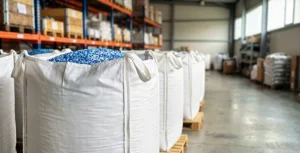
Rigid plastic packaging (cans, buckets, crates and IBCs), together with certain flexible packaging (bags and big bags), are currently priority areas for development.
Since 2019, Twiice has been running several pilot projects to develop new recycling streams for these specific flows.
Collection: a particular challenge for small waste holders
In France, 73% of professional packaging is collected separately, representing 5.4 million tonnes. This performance is mainly due to the structure of the waste stream: 86% of professional packaging waste comes from industrial companies, which are generally well equipped to organise sorting.
The situation is different for retailers, tradespeople, small service businesses and hospitals. Their separate collection rate is only 36%, due to operational constraints such as lack of space, limited collection frequency or lack of awareness of existing solutions.
It is specifically to support these stakeholders that Twiice provides financial incentives and tailored programmes: waste analysis, support for sorting at source and collection equipment.
Where does professional packaging reuse stand?
With an average reuse rate of only 3.46%, professional packaging remains well below national ambitions.
Reuse is not a new practice, however. Some sectors have demonstrated its relevance for many years. Wooden pallets, for example, have a reuse rate of 67%, making them a benchmark within the scheme.
The challenge now is to extend these models to other, less developed flows: cans, buckets, bottles, big bags, wooden crates and certain cardboard packaging intended to be replaced by reusable solutions.
| Turnover | 2025 | 2026 | 2027 |
|---|---|---|---|
| Less than €20m | — | 5% | 10% |
| €20m to €50m | 5% | 7% | 10% |
| More than €50m | 7% | 8% | 10% |
Targets for placing reused packaging on the market (Source: Decree of 8 April 2022)
The gap between the current rate of 3.46% and the 10% target for 2027 illustrates the scale of the transformation required. (Source: ADEME annual review, October 2025.)
European PPWR targets are even more ambitious: 25% for grouped packaging by 2040, 70% for transport and sales packaging used for transport within the EU by 2040, and 100% for transport packaging used between sites within the EU or within France from 2030.
How EPR accelerates reuse and recycling
The EPR scheme on professional packaging (EPRO) is not merely a new regulatory obligation. For the first time, it provides a national view of professional packaging flows, making it possible to measure collection, recycling and reuse performance more effectively and to focus investment on the most strategic waste streams.
It also provides companies with several practical levers: eco-modulation of contributions according to the environmental performance of packaging, financial support for reuse projects and improvements to sorting, and a premium designed to encourage the incorporation of recycled plastic.
Anticipate your obligations
Help move the scheme forward while preparing your company for the new requirements of EPRO.
FAQ
What is the difference between reduction, reuse and recycling?
These three levers follow a hierarchy: reduction means placing less packaging on the market or using more resource-efficient packaging; reuse means using the same packaging several times without it becoming waste between uses; recycling comes into play when the first two levers are not possible.
How is eco-modulation calculated in practice?
The amount varies depending on whether the packaging is single-use (full contribution), reusable (reduction of at least 50%) or actually reused (no new contribution). Other criteria, such as incorporating recycled materials or eco-design, may be added to this mechanism.
How can I prove that packaging is reused in order to benefit from eco-modulation?
Two separate mechanisms apply to reuse.
For packaging that is actually reused, no new contribution is due, provided that evidence of reuse is kept available for the eco-organisation and the quantities concerned are declared each year. For packaging placed on the market after 1 January 2027, it must also be possible to demonstrate that a contribution was paid when it was first placed on the market.
For reusable packaging, from its first placing on the market, an eco-modulation premium applies if it forms part of an effective reuse system: a reduction of at least 50% in the contribution, rising to 100% for packaging belonging to a standard range.
Do the AGEC and PPWR targets apply at the same time?
The two frameworks coexist, but their targets are not cumulative. French reuse targets apply until 2027, while from 2030 the PPWR introduces new European targets differentiated by packaging type and use.
Does my business sector have specific targets?
EPR targets are generally not defined by business sector, but by packaging type and use. The targets presented here are those set at national and European level for the scheme as a whole. Certain flows are nevertheless subject to specific targets or exemptions, including transport packaging for dangerous goods.
What happens if I do not meet the reduction or reuse targets?
These targets are set collectively at scheme level; there is no individual penalty for failing to meet them. Eco-modulation, however, encourages each company to improve its packaging in order to reduce its contribution.
Which packaging is excluded from European reuse targets?
The European reuse targets do not apply to transport packaging or sales packaging used for transport:
– used for the transport of dangerous goods in accordance with Directive 2008/68/EC;
– used for the transport of large-scale machinery, equipment and goods, where the packaging is specifically designed to meet the individual requirements of the economic operator placing the order;
– in flexible format, used for transport and in direct contact with food and feed within the meaning of Articles 2 and 3(4) of Regulation (EC) No 178/2002, or with food ingredients within the meaning of Article 2(2)(f) of Regulation (EU) No 1169/2011 of the European Parliament and of the Council;
– in the form of cardboard boxes and cardboard dividers;
pallet-wrapping films.