- EPR scheme 15 Oct 2026
To mark Global Recycling Day, Twiice wanted to highlight a very real challenge for professional packaging: recycling expanded polystyrene (EPS).
Widely used in logistics chains, this material remains difficult to recycle on a large scale. Yet solutions exist. Through a trial conducted with several partners and committed retailers, Twiice is exploring a practical approach to improving the collection and recycling of this material.
Expanded polystyrene boxes are widely used in E.Leclerc supermarkets, particularly at fish counters. But once used, managing them can quickly become a logistical headache.
Every year, around 55,000 tonnes of professional EPS packaging are placed on the market in France.
Fish boxes, cushioning for fragile products, protective corners, insulated containers… The uses are many and varied.
However, this lightweight material, largely made up of air, has one major constraint. Its very low density (7 kg/m³) makes collection and recycling particularly difficult, especially when flows are dispersed. This results in uneven sorting practices and recycling rates that are still well below national targets.
Solutions are emerging to capture these flows more effectively and make them easier to treat. The trial conducted by Twiice, in partnership with Valorplast and Tribord and with support from the Alliance to End Plastic Waste, is part of this effort.
It aims to simplify EPS management by offering a solution directly on site.
To test this system in real conditions, 23 E.Leclerc supermarkets and hypermarkets in Finistère have taken part.
So how can a material largely made up of air be recycled effectively?
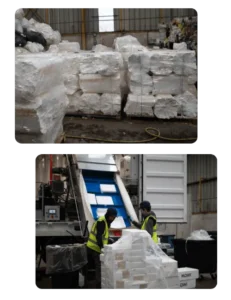
To address this challenge, Twiice, Valorplast and Tribord are testing a practical solution on the ground: a mobile EPS compacting unit.
The principle is simple (but someone had to think of it!): a truck-mounted press travels directly to waste holders (retailers, fish auction markets, businesses, etc.). On site, the EPS is compacted into dense blocks of material, greatly reducing its volume and making transport viable.
These blocks are then sent to recycling channels to be turned into new raw material, used in particular for:
Before the trial, Scarmor and its stores used a range of different solutions to treat polystyrene. EPS often ended up in the non-hazardous industrial waste stream, because there was no simple, effective sorting route.
The solution proposed by Twiice was decisive: a turnkey approach, with collection directly from our stores.
We have seen a major simplification in EPS management: it is now recovered rather than disposed of as general industrial waste. There is also a real financial benefit for our stores, particularly through fewer skip collections.
This type of initiative brings the circular economy into our operations in practical terms, by turning a challenging waste material into a recoverable resource.
The aim of this trial is clear: to recycle up to 100 tonnes of expanded polystyrene in one year.
Beyond the volume treated, this project shows above all what becomes possible when manufacturers, retailers and waste management operators work together to improve the circularity of professional packaging.
Expanded polystyrene recycling shows that, beyond the technical challenges, success depends on practical solutions suited to realities on the ground
By testing new collection and recovery models, Twiice supports businesses in implementing practical solutions to make their professional packaging more circular.
Would you also like to test this solution on your site?